Showing posts with label cement. Show all posts

Saturday, January 3, 2009

The cement that eats carbon dioxide


Cement, a vast source of planet-warming carbon dioxide, could be transformed into a means of stripping the greenhouse gas from the atmosphere, thanks to an innovation from British engineers.

The new environmentally friendly formulation means the cement industry could change from being a "significant emitter to a significant absorber of CO2," says Nikolaos Vlasopoulos, chief scientist at London-based Novacem, whose invention has garnered support and funding from industry and environmentalists.

The new cement, which uses a different raw material, certainly has a vast potential market. Making the 2bn tonnes of cement used globally every year pumps out 5% of the world's CO2 emissions - more than the entire aviation industry. And the long-term trends are upwards: a recent report by the French bank Credit Agricole estimated that, by 2020, demand for cement will increase by 50% compared to today.

Making traditional cement results in greenhouse gas emissions from two sources: it requires intense heat, and so a lot of energy to heat up the ovens that cook the raw material, such as limestone. That then releases further CO2 as it burns. But, until now, noone has found a large-scale way to tackle this fundamental problem.

Novacem's cement, based on magnesium silicates, not only requires much less heating, it also absorbs large amounts of CO2 as it hardens, making it carbon negative. Set up by Vlasopoulos and his colleagues at Imperial College London, Novacem has already attracted the attention of major construction companies such as Rio Tinto Minerals, WSP Group and Laing O'Rourke, and investors including the Carbon Trust.

The company has just started a £1.5m project funded by the government-backed Technology Strategy Board to build a pilot plant. If all goes well, Vlasopoulos expects to have Novacem products on the market within five years.

Jonathan Essex, a civil engineer at the building consultancy Bioregional who also sits on the environment and sustainability panel for the Institution of Civil Engineers, welcomed Novacem's ideas to tackle the carbon impact of cement. "In the UK the climate bill commits us to reduce CO2 emissions, and every sector should play its part. The construction industry needs to take greater responsibility for its own environmental impact." Essex said that, if Novacem can make their cement at a competitive price, the next step could be to take even more CO2 emissions out of the process by using renewable energy to fire the furnaces.

According to Novacem, its product can absorb, over its lifecycle, around 0.6 tonnes of CO2 per tonne of cement. This compares to carbon emissions of about 0.4 tonnes per of standard cement. "From that point of view, it's attractive," said Rachael Nutter, head of business incubators at the Carbon Trust. "The real challenge is what is the supply chain, who do you need to partner with to take it to market? The million-dollar question is what are the applications of it? If it ends up as decorative applications such as floor tiles, it's quite interesting but not as much as if you get into load-bearing structural stuff."

Previous attempts to make cement greener have included adding more aggregate to a concrete mixture, thereby using less cement. But this still does not tackle the problem of the carbon emissions from making the cement in the first place. Other systems use polymers in the mix, but none have yet made a significant impact on the market.

A spokesperson for the British Cement Association expressed a sceptical note, saying that though there was much ongoing laboratory work on new types of cement, there were also problems. "The reality is that the geological availability, and global distribution, of suitable natural resources, coupled with the extensive validation needed to confirm fitness-for-purpose, make it highly unlikely that these cements will a be realistic alternative for volume building."

Vlasopoulos responded that magnesium silicates are abundant worldwide, with 10,000 billion tonnes available, according to some estimates. "In addition, the production process of our cement is of a chemical nature, which means it can also utilise various industrial byproducts containing magnesium in its composition." He is confident the material will be strong enough for use in buildings but acknowledged that getting licenses to use it will take several years of testing.

Explainer: Ecofriendly vs traditional cement

Standard cement, also known as Portland cement, is made by heating limestone or clay to around 1,500C. The processing of the ingredients releases 0.8 tonnes of CO2 per tonne of cement. When it is eventually mixed with water for use in a building, each tonne of cement can absorb up to 0.4 tonnes of CO2, but that still leaves an overall carbon footprint per tonne of 0.4 tonnes.

Novacem's cement, which has a patent pending on it, uses magnesium silicates which emit no CO2 when heated. Its production process also runs at much lower temperatures - around 650C. This leads to total CO2 emissions of up to 0.5 tonnes of CO2 per tonne of cement produced. But the Novacem cement formula absorb far more CO2 as it hardens - about 1.1 tonnes. So the overall carbon footprint is negative - ie the cement removes 0.6 tonnes of CO2 per tonne used.

(via The Guardian.)


Wednesday, December 17, 2008

How to buy cement


There are two types of cement: Grey cement - used only for construction purposes, and White cement - for a variety of uses like mosaic flooring, in cement paints, and as a primer for paints, etc. Grey cement costs more than white cement because the production costs and excise duty are higher. White cement also sets faster. For grey cement, the strength after 28 days of setting is taken as the final strength. White cement achieves this strength in about three days time.

The cement has to be fine in texture. It should be smooth, dry and cool to touch. Fineness gives more strength to cement because the chemical reactions take place faster. Do not buy cement which is in rough, granular lumps. This indicates it has been exposed to moisture. Cement is now available in grades and is easier to buy . For eg: 53 grade cement implies that a cube of cement can withstand a pressure of 530 kgs per square centimetre. You can check this on a compressing machine. This is called the breaking strength of cement. Good cement hardens faster. You can therefore remove the scaffolding / formwork sooner than usual. You save on centering and labour costs, and your building is ready much faster.

(via ChennaiBest.com)

Wednesday, November 19, 2008

Protect, preen, paint


Exteriors of a house are constantly exposed to severely acting elements of weather. In India, the weather effect is quite variable -- sometimes, it is harsh sunlight and at others, severe and unkind winter. Rain, fog, high and low temperatures also tend to fade the exteriors. As the appearance of cracks and infestation of algae ruin the first impression of a house, owners seek an exterior paint finish that is able to resist all these weathering effects.

You have many choices for the exterior surfaces and the elevation. You can have exposed brickwork or plastered surfaces or a combination of both or cladding of walls with various types of stones or textured finish. While choosing exterior finish, our main purpose is to make the elevation look beautiful and appealing, to have a durable finish that survives for a few years, at least, to choose a finish that resists dust and weathering effects and the one that breathes -- allows moisture of walls to escape without hurting their beauty.

All these aspects can be well fulfilled through right choice of finish and proper workmanship. Here are a few guidelines for durable painting of exterior surfaces, but first choose what you want.

Exposed Brick

Many homeowners prefer exposed brickwork on the elevation. Since ages, man has been seeing exposed brickwork in buildings, monuments and forts and an inbuilt desire to have part elevation with it remains. However, the decision to have exposed brick in the elevation should be made early and one should keep sorting out good bricks while doing the brickwork of foundations and internal walls of the house and use these bricks in exposed brickwork for a uniform look. Otherwise, use mechanised bricks. When the exposed brickwork of external walls is in progress, do raking of joints to a depth of 10 mm at least while it is still green. Before applying paint, make sure to do pointing.

Pointing: Prefer deep pointing to flush. Flush pointing doesn’t look good on brickwork and mars its very character. Always begin deep pointing work from top downwards. See that all extra mortar is cleaned off and not smeared over the bricks. Do pointing work with 1:2 cement sand mortar. Take care that the vertical joints are truly at right angles to horizontal lines and any minor errors in brickwork are hidden by the pointing work. A very important point to see is that the vertical lines should not end away from horizontal lines nor should these extend into them creating ridges there. Cure the pointing work well for at least seven days.

Cement Paint

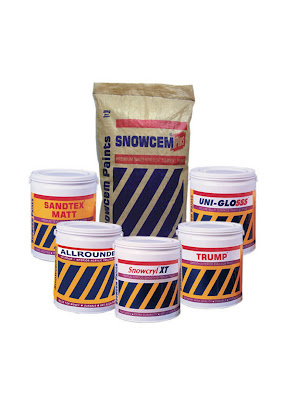
If you choose cement paints, commonly known by the trade name Snowcem, on external surfaces, choose a reputed brand like Super Snowcem by Killick Nixon or the one by Asian Paints. Always choose from a fresh lot and see that the bags are IS 5410 marked. Open a bag, feel the Snowcem in your hand and see that it is free of lumps. In general, cement paint bags or sealed drums showing date of manufacture as within one year of purchase are considered fit but try to get a lot as fresh as possible. Reason for this is that cement paints are just a mixture of cement and pigments and cement attracts moisture from air and loses strength with time. So, don’t go by the expiry date on the bags or drums but get a lot as fresh as possible.

Preparation: While preparing cement paint for exterior walls, take care that dry powder is added to water and not water to powder. First take 50 per cent quantity of water to make a paste and then add balance 50 per cent to make a workable mix. Always mix thoroughly. At one time, mix only a quantity that will get used up within an hour of mixing with water. Otherwise, the paint mixture will start setting, will lose strength and brush marks will appear on surfaces.

The coats method: Clean exterior walls of dirt, dust, loose material and efflorescence with wire brush and then by washing, before applying the first coat of Snowcem. Thoroughly wet the surface before applying paint. Apply second coat after 24 hours of first. However, you need not wet the surface before applying second coat. After second coat, keep the surface fully wet for next two days by spraying water on the paint and not by throwing water with a pipe or container. I recommend a fog spray. It is a tried method and yields best results.

Texture Paint

In case you don’t want to paint the exterior plastered walls with Snowcem, consider Birla White Textura. Textura is also a cement-based paint but gives a textured wall finish — as the name suggests — instead of a plain surface. It comes in a variety of textures and designs. Unlike acrylic paint, no primer coat is required and is an economical textured finish. Above all, Textura needs no curing, has extra adhesive strength and resists water and weather. It is mixed with water and applied with trowel or roller or spray. Roller or spray finish textura is termed as RF while trowel finish textura is called TF.

The method: Prefer to use RF textura on interior surfaces and TF textura on the exterior. Textura contains Birla white cement, some minerals, polymers, quartz sand and additives. You can apply it even on damp walls. Textura TF and RF are sold in 25 kg bags. A bag costs around Rs 700. Generally, a bag cover gives 100 sq ft. area. Though the textura shade card may show many colours, it is applied only in white colour and then paints like Apex are applied over it. Its overall cost, including labour, should be about Rs 16 to 18 a sq ft. While applying, take care that at one time, only that much quantity is prepared that can be used up in 1.5-2 hours. To prepare its solution, add about 45-50 per cent water to it. If you want to use the spray method, some more water may be added to make it sprayable with a gun.

Acrylic Emulsion

Cement paints used for painting external surfaces of walls are not fully resistant to algae and fungus. Other paints available are semi acrylic and 100 per cent acrylic exterior emulsion paints. These paints give extremely good performance and also provide protection against fungus and algae. However, these are many times costlier than Cement paints. Therefore, you must make your cost calculations and buy paints your budget allows. All inclusive cost of semi-acrylic paints is around Rs 6- 8 per sq ft. This includes labour component. Good semi-acrylic paint costs around Rs 100-125 a litre. One litre should cover about 50 sq ft. area in two coats. No water curing of this paint is required.

Cost factor: For really good results, choose a 100 per cent acrylic exterior emulsion paint. It costs around Rs 180-220 a litre and covers around 50 sq ft area in two coats. All-inclusive cost of its application shall be about Rs 10-12 per sq ft. Today, labour component is very high and tends to equal material cost if you engage skilled painters. Do no water curing for this type of paint as well.

More tips on paintwork shall follow. Till then, happy painting!

(via Tribune India)

Saturday, November 15, 2008

Tips for cement paint


Cement paint is water based paint and is applied on external walls/surfaces of the house. It is made from cement with different pigments and gives the best results on newly concrete surface. It can also be applied on bricks. It gives the best results on newly concrete surface but it should not be applied on white wash, color wash and dry distemper.

According to Indian standard cement paint should confirm IS: 5410 of approved brand and manufacturer. ‘Snowcem’ and its variants are a popular brand. They contain white or colored Portland cement with water proofing agent accelerator and extender.

Characteristics

  • Highly water resistant
  • No primer is required
  • Most suitable for worse environments
  • No chance of drying up due to its solid form

Guidelines for Surface Preparation

  • The surface should be cleaned of all mortar dropping, dirt, dust, grease and other foreign matter by brushing and washing.
  • Patches in plaster should be repaired and a coat of waterproof cement paint should be applied over patches after wetting the surface completely.
  • The surface should be cleaned thoroughly by scrapping of all whitewash; color wash if water proof cements paint is required to apply on existing surfaces previously treated with white wash and color wash.

Mixing Procedure

First Stage: The first stage consists of 2 parts of cement paint and one part of water stirred thoroughly and stands for 5 minutes. Care should be taken to add cement paint gradually to the water and not vice versa.

Second Stage: The second stage comprises of adding remaining one part of water to the mixture and stirring it thoroughly to obtain uniform stability.

Guidelines for Application

  • Painting work should be started after preparation of the surface.
  • Cement paint should be used within an hour after mixing otherwise the mixture would be set and thicken which affect the flow and finishing.
  • Before applying cement paint, the cement or concrete surface should be wet thoroughly to provide moisture to aid in proper curing of the paint.
  • The surface should be moist not wet when the paint is applied.
  • The solution should be applied on the clean and wet surface with brushes or spraying machine.
  • The solution should be stirred well during the period of application.
  • The solution should be applied on shady surface of the buildings so that direct heat of the sun may be avoided on the surface.
  • The completed surface should be watered after days work.
  • The second coat should be applied after first coat is set at least for 24 hours.
  • Water proof cement paint should not be applied on the surface treated already with white wash, color wash; distemper dry or oil bound distemper, varnishes, paints etc.
  • It should not be applied on gypsums, wood and metal surfaces.
  • In special cases a coat of cement primer should be applied followed by two or more coats of water proof cement paint.

(via Gharexpert.com)