Tuesday, November 20, 2007

The simple home: The luxury of enough

Sarah Nettleton presents her six paths to simple sustainability, each illustrated by examples of human-scaled, unadorned homes with straightforward floor plans from her book, The Simple Home. For everyone who craves a simpler lifestyle, not only in how they live but also where they live, her book features 21 houses and presents six different approaches to creating a home that realizes its full potential both simply and elegantly.

Her six paths to simplicity are each illustrated by human-scaled, unadorned homes with straightforward floor plans and forms. These are open, light-filled houses (with rooms or spaces that are often multipurpose) that express their beauty in their utility and practicality. Simple homes are low maintenance and often green, designed for homeowners who wish to embody a different set of values in their housing choices than the run-of-the-mill starter castles littering the landscape.

The 6 Paths:

  1. Simple is Enough
  2. Simple is Thrifty
  3. Simple is Flexible
  4. Simple is Timeless
  5. Simple is Sustainable
  6. Simple is Refined

In this podcast, Nettleton discusses living in complex times, in a commodified, virtual, and overstimulated culture, and how to escape that reality for a more satisfying life through simplicity. By using architecture, she tries to at once give a vocabulary to common sense concepts of the simple, while at the same time offering concrete examples of what steps can be taken towards living a new lifestyle.


Monday, November 19, 2007

How to prevent paint from peeling


Question
I recently purchased a house 3 years ago and have noticed a lot of peeling and cracking problems reoccurring every year on the sunny side of the house. I don't know the painting history of the house. I have cedar clapboard with the smooth side out. The peeling occurs at the base level leaving bare wood exposed. I was told the best way to cure the problem is to strip the house to get all the paint off down to the wood. Sand and power wash the wood. Then apply one coat of oil based primer and finish with acrylic latex paint. They said the first paint job on the house which is 10 years old must have been bad and the expanding and contracting of the smooth clapboard on the sunny side of house keeps causing the problem. They say oil primer and latex paint will provide more flexibility. Is this true? Should I use solid stain instead? What do you feel will cure the problem. Thanks !!!

Answer
There are several things that could be causing the problem, so you'll have to take steps to address them all. Yes, it will be best to remove all the old paint and primer, using scraping, sanding, etc. Then, all exposed wood should be sanded with medium (#120) grit garnet paper. Be sure excess moisture can get out from behind the wood.

Consider installing "button" vents at the top of the wood siding, away from the weather. Consult with your building supplies house for guidance on type, size and spacing of the vents. All cracks and joints should be cleaned of old paint and sealed with a TOP OF THE LINE quality acrylic or siliconized acrylic latex clear (guns white/dries clear) caulk. Do NOT seal the lower edge of the clapboard siding, where it meets the next piece. Moisture must be allowed to make its way out. Any rough edges of wood or any remaining paint should be feather-sanded. You can use either a latex or oil-based exterior wood primer: oil types will block stains better; latex will resist cracking better.Apply a heavy coat of the primer. Dry over night, then apply one or two coats of top of the line 100% acrylic latex flat or satin house paint.

Don't apply primer or paint in the direct, hot sunshine. If the rest of the house is OK, then just prepare the surface for repaint (without removal of the old paint) and apply the same finish coat.

Saturday, November 17, 2007

Realty barons steal limelight

India’s booming real estate sector has more than doubled the number of billionaires from this space in just 12 months, with DLF’s Kushal Pal Singh emerging “the world’s richest real estate developer.” Among 54 Indian billionaires identified by Forbes magazine, there are seven real estate developers with a net worth of over a billion dollar each.

A year ago, there were just three billionaires from this sector — K P Singh, Ramesh Chandra and Rajan Raheja, who have now been joined by Rakesh Wadhawan of newly listed HDIL, Niranjan Hiranandani of London-listed Hirco, Parsvnath Developers’ Pradeep Jain and Omaxe’s Rohtas Goel.

Singh, the wealthiest in this space, has been ranked as the fourth richest Indian with a net worth of $35 billion, according to the Forbes List. His wealth appreciated over 250 per cent after his company, DLF, went public in June this year and the stock has surged 60 per cent since then, it added. Unitech’s Ramesh Chandra ranks 8th with a net worth of $11.6 billion, followed by Wadhawan at the 26th spot with a wealth of $2.35 billion.

Friday, November 16, 2007

Tips on painting your interior and exterior

The various choices available for paints for interior walls are as follows: Paints for interior walls can be water or solvent-based. In water-based paints there are three choices available i.e. premium emulsions, acrylic emulsions, and distempers. Premium emulsions give a smooth finish, are corrosion resistant, have high durability and are the most expensive of the three. Acrylic emulsions give a smooth matt finish, they are washable, easy to maintain and less expensive. Premium and acrylic emulsions are popularly known as plastic emulsions.

Now regarding an economical option for interior paints, distempers are an economical alternative to emulsions. Once again these are oil and acrylic-based. Of the two, acrylic distempers are superior in finish. If economy and value for money is the criteria for choosing the paint then oil-based distemper would be your choice.

Solvent-based paints are the second choice for interior paints i.e. these paints are to be mixed with a solvent such as turpentine oil. Basically they have a different chemical composition. They are of two types — flat oil and luster finish. Flat oil paints give a matt or porous texture and are best suited for ceilings. Luster finish paint gives a silky finish and a smooth sheen. They are durable and do not loose sheen even after washing. They are superior paints at a reasonable price.

Regarding the exterior of the house there are the following types of paints and you can decide upon which paint to use depending on your requirement.

Emulsion Paint: These paints are suitable for wall areas of masonry and wood. Nowadays modern high performance acrylic multi-surface paints are suitable for previously unpainted wood and metal if properly prepared and primed. These paints come in matt and satin finishes, which give protection and colour. Exterior emulsion paints are commonly water-based, so are easily cleaned with soapy water. These paints are microporous, allowing the painted surface to breathe, so minimising blistering and flaking otherwise caused by moisture coming from within the building.

Masonry Paint: These paints can be used on masonry, render, pebbledash, concrete and brick. These come in smooth or textured finishes and are also available as 1-coat products. They contain fungicide for anti-mould properties. These paints give a smooth finish that resists dirt pick-up and the textured-finish paints are good for hiding minor imperfections.

Gloss Paint:
These paints are used for exterior wood and metal surfaces. These paints give a tough and durable protective finish. These are available as 1-coat paints and come in satin or gloss finishes. Gloss paints are dirt and mould resistant and non-yellowing.

Floor Paint:
These paints are recommended for the concrete surface of garage floors and stone steps. These are tough and durable paints and can withstand heavy wear and tear. They are water or solvent-based and can be applied with a roller. Ideally one should ensure loose bits are wire-brushed and cleaned before sealing, priming and painting.

Metal Paint:
These paints are for use on metal surfaces such as gates, drainpipes, garden furniture and garage doors etc. These paints are designed to give protection to the metal surfaces and they come in gloss or satin finishes. It is recommended to remove rust prior to painting and use a wire brush and fill pitting with epoxy-based filler (a rust inhibitor). Degrease the surface prior to painting metal in thin layers using soap and water. If the paint is sprayed on to the metal surface then wear protective clothing, including goggles and a face mask and ensure the protection of surrounding areas.

Waterproof Paint:
These are used on metal gutters, drainpipes and concrete. These are bitumin-based to create a waterproof surface. Remember, do not over paint waterproof paint with ordinary paint — it can only be repainted using another bituminous paint.

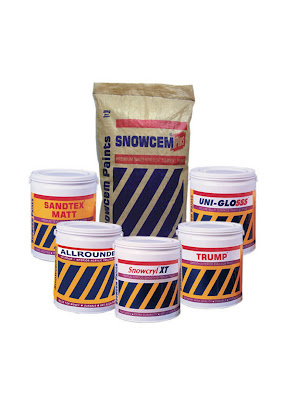
Snowcem Paint:
These are the most commonly used paints for exterior surfaces. These are cement-based paints.

Advertisement

Now regarding your last query about paints and colours. A single painted wall or a room with all walls in a certain colour can totally change the look and mood of the room. A single painted wall can become the accent wall of that particular room and can be used to display photos, paintings etc. Be careful while using colours since one must keep in mind factors such as the amount of time spent in that particular room. Some bright colours can make the rooms look smaller, while softer lighter shades can make the same space appear bigger.

Broadly speaking, human association with colours can be in four different categories. Colours can be warm (orange, yellow, red, etc.) or cool (shades of blue, green, etc.). Secondly, they can appear heavy (dark blues, reds, purple, etc.) or light (peach, lemon, lilac, etc.). Thirdly, colours can be perceived as having depth i.e. they appear to be receding (shades of blue, green, violet, etc.) or advancing (shades of red, orange, yellow, etc.). Lastly, colours can have an appetising effect i.e. food colours (green, orange, yellow, etc.). Keeping these factors in mind decide upon the colours for the various rooms or walls.

Thursday, November 15, 2007

Ludwig Mies van der Rohe

The United States has a love-hate relationship with Mies van der Rohe. Some say that he stripped architecture of all humanity, creating cold, sterile and unlivable environments. Others praise his work, saying he created architecture in its most pure form.

Ludwig Mies van der Rohe began his career in his family stone-carving business in Germany. He never received any formal architectural training, but when he was a teenager he worked as a draftsman for several architects. Moving to Berlin, he found work in the offices of architect and furniture designer Bruno Paul and industrial architect Peter Behrens. In 1912, Mies van der Rohe opened his own practice in Berlin and he adopted his mother's maiden name, van der Rohe.

Early in his life, Mies van der Rohe began experimenting with steel frames and glass walls. He was director of the Bauhaus School of Design from 1930 until it disbanded in 1933. He moved to the United States in 1937 and for twenty years (1938-1958) he was Director of Architecture at the Illinois Institute of Technology.

Mies van der Rohe taught his taught students at IIT to build first with wood, then stone, and then brick before progressing to concrete and steel. He believed that architects must completely understand their materials before they can design.

Mies van der Rohe was not the first architect to practice simplicity in design, but he carried the ideals of rationalism and minimalism to new levels. His glass-walled Farnsworth House near Chicago stirred controversy and legal battles. His bronze and glass Seagram Building in New York City (designed in collaboration with Philip Johnson) is considered America's first glass skyscraper. And, his philosophy that "less is more" became a guiding principle for architects in the mid-twentieth century.

Skyscrapers around the world are modeled after designs by Mies van der Rohe.

Wednesday, November 14, 2007

Mumbai is the world's fourth most expensive office market


Mumbai the world's fourth most expensive office market; Delhi not far behind

In August this year, ABN Amro Bank decided to renew the lease for its 3,100 sq ft office space at Nariman Point’s Sakhar Bhavan, but the landlord dropped a bomshell by jacking up the rental to Rs 500 per sq ft. The earlier lease, signed in 2004, was for Rs 180 per sq ft.

At the revised rate, the rent of $150 per sq ft per year was around 90 per cent more than even mid-town Manhattan where the annual rates are around $82 per sq ft. But ABN isn’t alone in deciding to pay up top-dollar rentals for new office space in Mumbai.

The Rs 500 per sq ft rate has, in fact, become a benchmark for Grade-A office space — centrally air-conditioned, well-maintained, efficient buildings (space you get in terms of what you pay for) with good tenant mix — in Mumbai’s main business districts.

Real estate brokers say landlords at Hoechst House in Nariman Point are demanding similar rentals. A landlord on Maker Chambers VI is close to signing a deal at Rs 500 per sq ft for a higher floor office with unobstructed sea-view.

Now, this rate is for chargeable (super built-up) area in a building where previously most deals were done on carpet area. So, the effective rentals could be Rs 575-650, excluding property taxes and maintenance charges.

The scene is no better in other business districts like Worli, Parel or Bandra-Kurla Complex in midtown Mumbai. New deals for Grade-A buildings are being signed in the Rs-400-500 per sq ft rent bracket.

Last quarter, Dubai-based real estate firm Limitless leased out 6,500 sq ft at the IL&FS Financial Centre, Bandra-Kurla Complex at Rs 430 per sq ft, while Morgan Stanley took 12,500 sq ft in Peninsula Corporate Park, Parel, for Rs 400 per sq ft.

No wonder, Mumbai has emerged as the fourth most expensive office market in the world, next only to the two business districts in London (Westend and City) and one in Tokyo (inner central).

A survey by real estate consultant CB Richard Ellis (CBRE) in May 2007 shows New Delhi isn’t far behind at the seventh slot and estimates occupation costs in Connaught Place at $116 per sq ft/annum.

The rates have gone up further since the survey. Real estate brokers say the going rate at the Birla Building on Barakhamba Road in the capital is Rs 600 per sq ft.

Ashutosh Pathare, vice-president, Shapoorji & Pallonji, says there is a mismatch in supply in Nariman Point. There’s very little space available but there’s strong demand from private equity firms, banks, airlines and consultants.

Agrees Sanjay Dutt, deputy managing director with real estate consultant Cushman & Wakefield India: ‘‘Nariman Point has an estimated 7 million sq ft of commercial space, but not even 3 per cent of this is available for lease.’’

But it’s not just about Nariman Point. Commercial rentals across Mumbai have shot up 15-20 per cent as supply has failed to keep pace with the spurt in demand, say real estate observers.

BPO major Firstsource recently renewed its lease at Peninsula Corporate Park, Parel at Rs 225-275 (basic rent, plus other costs like taxes and maintenance), revising it from the Rs 70-80 per sq ft when it moved here in January 2004.

‘‘The spurt is higher in case of renewals,’’ adds a real estate expert. The rentals also depend on the amount of space a company lease out. If the area is huge (30,000 sq ft), the rentals could be lower, and vice-versa.

‘‘The price rise is a temporary phase as there is no space available. But this is not sustainable in the long run,’’ said Anuj Puri, CEO, Jones Lang Lasalle-Meghraj.

The market is likely to remain tight in the next few months till new supplies come in. Mumbai will add 22 million sq ft of Grade-A office space in the next two years.

Jones Lang Lasalle-Meghraj estimates the Grade A office space in Mumbai to double by 2008-09 from the existing 19 million sq ft. These should ease pressure on commercial rentals if the supplies-in-the-pipeline come on time and there’s no slip in delivery dates.

Tuesday, November 13, 2007

Fazilka's innovative way to prtects its heritage

Fazilka is setting up new trends in Indian History. First time people of Fazilka came forward to protect their heritage monuments linked with historic Importance of Fazilka. Fazilka is a historical town, established by Britisher Van Pat Agnew in the year 1844. Since its inception many historical monuments are being built here, important one is Fazilka's City Centre, Ram Narayan Pediwal Clock Tower.

Mission started by Graduates Welfare Association Fazilka (GWAF)on 30th June 2007 along with Press Club Fazilka, Pediwal Trust and Pediwal Family (Family who established clock tower), Manav Kalyan Sabha, Bharat Vikas Parishad, Municipal Council Fazilka. Arya Samaj and many other volunteer people and organisation are taking its shape. Bajrang Gupta, ex-president Municipal Council fazilka contributed special role to execute the same.

Opinion from Berger India, Nerolac Paints, Asian Paints and Snowcem Paints were called. Snowcem paints were shortlisted for the final execution of the Work. They will not just paint the structure but will protect the monument. Mr. J. S. Saini and Mr V.Lakhanpal from Snowcem Paints taken up this project around month back and they have developed four different models to paint and protect this historical clock Tower Fazilka. Apart from business angle Snowcem India people personally providing their full technical support as a part of their corporate social responsibly.

Ram Narayan Pediwal Clock Tower Fazilka Inaugurated on 6th June 1939. Since then, this is adding beauty to the city skyline. Two of this type clock towers are built in the world, another one is in the Lyallpur Pakistan. Due to poor maintenance by Municipal Council Fazilka and political negligence after militancy era in Punjab. This structure was losing its charm. With this initiative, this small town is setting trends for the rest of the world.

Through online and offline methods, polling will be conducted to take peoples opinion for the most suited colour scheme on this structure. These online polls soon will be available on the Fazilka website www.lovefazilka.esmartweb.com.

Talking to media persons, Mr. Sushil Pediwal, Member Pediwal Trust Fazilka said "our culture and heritage is our pride and these historical monuments link us with the past legacy set by our elders, we must protect the same for our future generations".

Dr Bhupinder Singh and Mr. Umesh Kukkar, founder members of GWAF are appealing to the entire citizen to participate in this campaign. After clock tower, historical Asafwala War Memorial built in the memory of Indian martyrs of 1965 and 1971 Indo-Pak war shall be taken up.


(via Punjab Newsline.)